Wine Diary - January 2025
Welcome to my new regular wine rantings article (assuming, of course, I don't get lazy and just give up after this one). These articles will be 100% Vino (not much chance of any Moto right now anyway with all the storms and sideways rain). I'll write about anything wine-related I've done recently that's worth mentioning—interesting wines I've tried, wine books I'm reading, wine bars and events I've been to, etc. It gives me something else to write about when I'm not just back from a trip or planning the next one—"For the days when you can't ride your bike, there's always..."
I want to get articles out more regularly. The travel guides seem to take me months to do, so I'm going to try some new formats this year. Originally, I was going to stay away from just writing about wine. There are enough great wine writers out there, and I didn't want to be posting pictures of wine bottle labels and going on about what berries and herbs the wine tastes of. Also, when I wasn't travelling, most of the wines I'd been drinking were from work, and I didn't want to just be plugging wines from my job.
A lot has changed for me on the wine front over the last few months, so now I feel I've enough to write about throughout the year.
Firstly, I work as a software developer for a small (but growing steadily) online wine retailer, but now I'm getting involved in the wine buying side of things, so I'll be going to more trade tastings. In February, I'm going to my first international wine trade shows in Barcelona and Paris. I used to go to trade tastings a lot when I worked in a wine shop in London, so it'll be nice to get back to that.
Secondly, before Christmas, I did the WSET (Wine & Spirits Education Trust) Level 3 course, which has had quite an impact on my life. I haven't been living in Bath long, and the course has allowed me to meet some great local people, many of whom work in the local wine companies or restaurants. This has led me to join a weekly wine tasting group, and when I'm not at that, I've been out in the local wine bars regularly trying interesting wines with my newfound wine buddies. The course also reenergized me to learn more about wine, and I'm now looking towards the next level in WSET, the Diploma.
Wine Education / My Journey Into Wine
Having just completed a wine course, I thought I'd talk a little about wine courses and how I've to got to where I am on my wine journey.
There are probably 3 main organisations providing accredited wine courses, these are all suitable to wine professionals and wine enthusiasts. The WSET courses are probably the best known and widely respected wine courses globally. Their HQ is in Bermondsey, London, so they are particularly popular in the UK & Ireland. Then there is the Court of Master Sommeliers, which is geared more towards those working as sommeliers in restaurants and seem to be more popular in America. If you've ever seen any of the non-fiction Somm films, that's those lot. And finally, there's the lesser-known Wine Scholar Guild, who do courses for individual countries (France, Spain, Italy, and now Germany) and regions (Champagne, Burgundy, Sherry, etc.), so a good option if you have specific interests.
I personally only have experience with the WSET which has has 4 levels of qualifications in wine (they do beer, spirits and sake also). Level 1 is for people who don't know wine is made from grapes (considered a waste of time), level 2 is where professionals start and is perfect for enthusiasts interested in doing a wine course, level 3 is as high as most wine professionals go and is quite a step up from level 2. Then there's the level 4 Diploma, the flagship WSET course, which is a massive step up from level 3 and typically takes 2-3 years to complete and is, in my eyes, akin to doing a part-time MBA.
Back in the early 00s in Dublin, I worked for 5 years in my local wine shop during college, where I was studying Computer Science. When I started in the wine shop, I knew nothing at all about wine and had barely drank any, so work sent me off to do the WSET Levels 2 & 3. The courses lasted 8 and 12 evenings respectively, so one evening a week I'd ride off on my little 80cc Honda sports bike to a posh hotel off St. Stephen's Green and learn about wine. I was hooked on wine from that point on.
Finishing college, I worked as a software developer in the healthcare sector for 10 years, the last 7 in my own company. My interest in wine lay somewhat dormant until about 2014 when I had a renewed interest from listening to wine podcasts on my hour's walk to work. I then started reading lots of about wine and attending any wine events going on. My company was wound up and I moved to London and started to work in a large wine shop near Twickenham. We'd get to try lots of wine in work and I'd go to many trade tastings which was great, but shop life wasn't for me. I left after 6 months and became a freelance software developer of e-commerce websites. I reached out to some wine companies and found myself a little niche of working for wine companies and other industries where needed.
Fast forward to January 2020, I was working full-time for a wine company. I'd got the go-ahead from work to take the WSET Diploma (Level 4), but I was then told by WSET I'd need to retake Level 3 as mine had apparently gone out of date. Does education go out of date? Apparently so. Seemingly, the course had changed enough in the 16 years since I'd done it, and, as I would discover, it was much harder now. Work went bust shortly after, COVID went into full swing a few weeks later and I needed to take a job so I went to work for a luxury interiors company. Wine study fell off my to-do list.
I've been back working for a wine company now for the last few years now and am living in Bath. Last autumn, I was walking past my local wine bar (Beckford's Bottle Shop) and they had a chalkboard out front advertising the WSET Level 3 course starting in a few days' time. They wouldn't be doing it again until 2026, so it was a no-brainer to take the course in my lovely local wine bar. The course was 6 full days (every Monday for 6 weeks) with an exam at the end.

When I took the older version of the course in 2004, my exam was in the middle of my college final exams, so I only had one day to study, but I still passed and assumed this time round things would be similar. I was very much mistaken, considering I knew far more now than in 2004, I studied solidly for a month and still went into the exam unconfident of passing. I was told the passing rate for those taking the course was 50%, and you needed to individually pass (scoring 55% or above) in each part of the exam: a) the tasting/analysis of 2 wines, b) 50 multiple-choice questions, and c) 4 long-format essay-style questions.
The tasting exam is tricky as you're marked against your tutor's analysis of the wine, so they could have a totally different sense of smell/taste than you, so you need to calibrate to them. However, the pass rate for the tasting is much higher (80%+ I believe). For the duration of the course, I'd meet other students to practice blind tasting of wines (where you don't know what the wines are, rather than being blindfolded). If you've read the course book at all, then it should be easy to do very well in the multiple-choice questions without much effort. The long questions were what everyone was worried about, and this is where most people fail. There's no choice, so if you don't know one of the questions, you're totally screwed.
A couple of weeks ago, I got my certificate, and despite thinking at best I scraped a pass, I was delighted to come out with a Distinction (average 80%+). My classmates involved in wine-related professions also did very well in the exams, but those not employed in the industry struggled. The course is particularly challenging for those who aren't exposed to wine daily at work and are attempting to juggle the course with a full-time job.
The level 2, by contrast, only has 50 multiple-choice questions, so provided you read the course book at all you're fine and can just focus on enjoying yourself. Personally I think anyone who drinks wine would benefit from doing this course. I certainly remember it being a total eye opener when I did it. You might just drink the same wines from the same countries all the time and this is a great way to open you up to all the wines of the world and learn how they're made.
I'm now looking towards starting the Diploma later this year when I get back from a few trips I've planned. I'll probably take the online version rather than commute to London and I'm looking to get together a local group to take the course with me so we can support each other. As I mentioned, this is a huge step up, and the amount to learn is vast. There are 5 exams (winemaking/viticulture, wine business, sparkling wine, fortified wine, and still wines of the world) and a research dissertation project. The detail of the wine tasting exams is higher, and the still wines of the world exam is a killer as the amount to learn for this one exam is insane. So until I start the course, I'm going to work on my tasting skills and do some prep for taking on this course.
There are a couple of free online wine courses on my to-do list because they focus on two of my favourite wine regions - Tuscany and Sherry. I had planned to complete them over Christmas, but things didn't go as planned. The first course is the Chianti Classico Expert offered by the Chianti Classico Consortium. If you want to learn all about Chianti, then this looks like a great resource. Additionally, there are several Sherry courses available, and I'm particularly interested in the advanced one. There's also a basic one for those who are new to Sherry and even one on Sherry vinegar.
Wine Travel Plans for 2025
Seeing as it's the new year, I may as well mention which wine regions I'm hoping to travel to this year.
As I mention in an upcoming issue of a motorcycle magazine article I've just submitted to, I'm building up to ride to the birthplace of wine in Georgia/Armenia. Depending on the Diploma workload, I think this might be feasible in 2026/2027. I reckon it'll take me months to do so I may need to do it in stages. I'll be exploring the wine regions along the way, going through places like Greece and Turkey. Bath to Baku has a certain ring to it ....
So then what's in store for 2025? There's nothing set in stone yet but ideally I want to do the following ...
Firstly, I've been neglecting the English wineries for far too long. I've visited about 20 already but not really since COVID. I drink a lot of English sparkling wines, which are generally very good, so I want to do more local wine tourism.
In July, I'm aiming to revisit BMW Motorrad Days in Garmisch-Partenkirchen, Bavaria. I haven't been since 2009 when I was "that guy" parking my red Ducati Monster in the sea of BMWs. If you don't know it, think mini Oktoberfest with loads of BMW bikes. I plan to ride down through Champagne, Alsace (a firm favourite of mine) and then explore the Alpine passes (I'm currently reading Goldfinger, so I want to tick the Furka Pass off my bucket list). I'll hopefully pick off a few Italian alpine wine regions along the way. I'll pop up in Bavaria then for Motorrad Days before exploring all the famous German wine regions on the French border and maybe even ride through some in Luxembourg. I've always struggled to understand German wines, so I'm hoping a visit there will help with this, and there are some nice scenic biking roads along the way. Some of the regions I visited last year appeared on my recent WSET exam, which was a help, so I'm hoping it'll help me for the Diploma too.
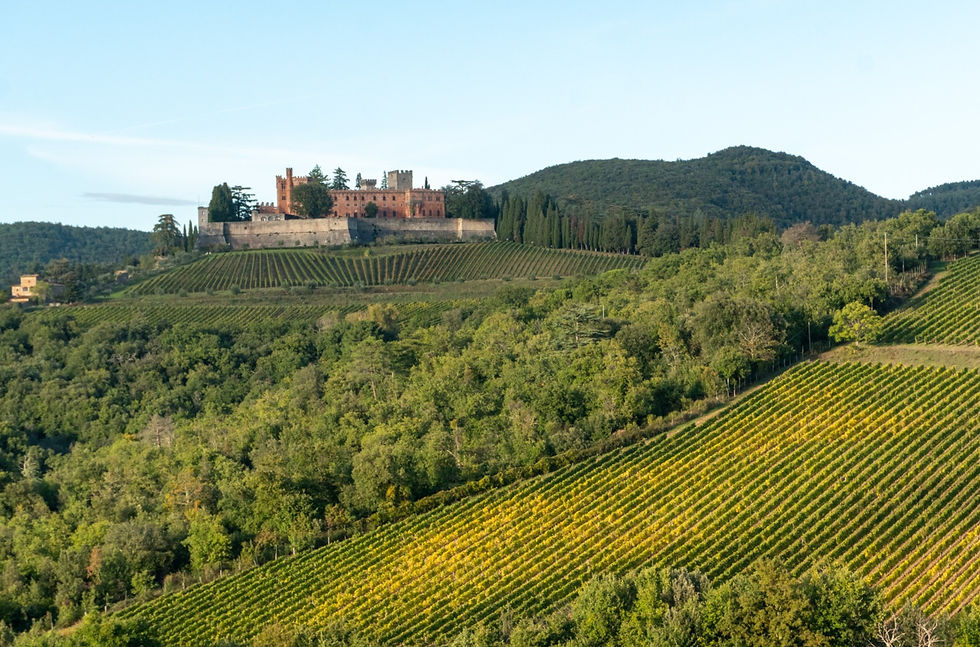
Last year's big trip revolved around Spain and Portugal. I love Italy, and many of my favourite wines come from there, so I plan to explore some regions I haven't yet visited, along with revisiting some of my favourites. Counterintuitively, my Italy trip will begin in the Spanish Pyrenees as I go back to take part in this year's edition of Austin Vince's The VINCE near Andorra. From there, I'm planning to ferry from Barcelona to the islands of Sardinia, Corsica, and Elba before exploring Tuscany and central Italy. There's a 208km white gravel trail through the Tuscan vineyards, well known to cyclists, often referred to as "The Eroica Trail," which I've been dying to do. From there, who knows.
What I've been Reading
Mentions of a trip to Tuscany segues nicely into the current wine book I'm reading - On Tuscany, compiled by Susan Keevil. I'll be the first to admit that many wine books can a tough read and as much as I love a good wine map, there's only so much of that kind of book I can deal with. On Tuscany is a great book to dip in and out of, it's essentially a collection of short stories with interesting anecdotes about Tuscan wines and how they came to be what they are now. Each story is written by a different wine expert such as Jancis Robinson and Monty Waldin.
I highly recommend this book but if you're not into Tuscan wines then not to worry as there's a series of them - On Burgundy, On Bordeaux, On Champagne and On California. The On Champagne book is probably next on my shopping list.
I bought mine from my great local book shop Topping & Co - Buy On Tuscany

What I've been Drinking
Despite my "best efforts" at having a dry-ish January, it's been pretty wet. This hasn't been helped by our excellent new wine bar in Bath, 18 Green Street, where I seem to end up at least a couple of evenings a week. Add in my weekly tasting group and a couple of wine dinners, and I've tried a lot of wines this month. What has particularly stood out, though...
As I mentioned, I'm a huge Sherry fan. Sherry can be rather confusing to people—it comprises some of the world's driest and sweetest wines, some aged under a layer of yeast called flor, others deliberately oxidized, and others a combination of all of these things. If you don't know much about Sherry, have a read about it on sherrynotes.com or the official Sherry website. I've found from running a few tastings that everyone found one style they liked. I thought I had a good grasp of all things Sherry—I’ve read various books on the subject cover to cover, but I seem to have taken my eye off the ball a bit in the last few years. As far as I'm aware, Sherry hasn't changed much in my lifetime, except to decline in popularity; grannies notwithstanding, it's seemingly now mostly drunk by wine nerds and mixed into the odd cocktail. Thankfully for those interested in Sherry, this has meant Sherry is probably the best price-to-quality wine you can buy.
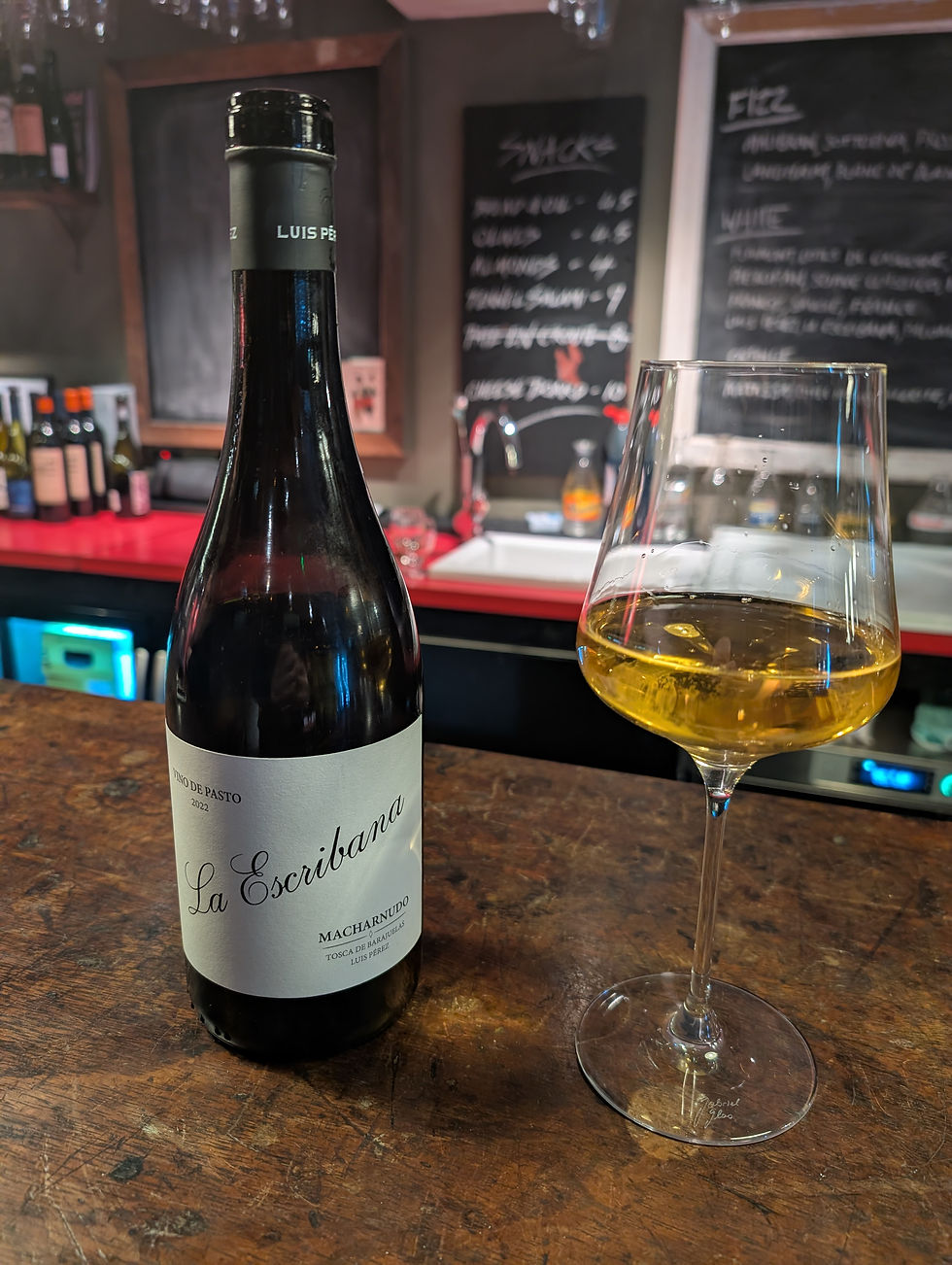
Recently, at 18 Green Street, I've been drinking some amazing unfortified vintage "Sherry" such as La Escribana 2022 by Luis Pérez, which was aged under flor yeast for a year. La Escribana is a beautifully rich white wine with distinctively Fino Sherry notes and is the most memorable wine I've drunk recently. This style of wine offers an excellent "gateway drug" into Sherry, somewhat of a hybrid between a white wine and a dry Fino Sherry.
So what does one classify these unfortified, vintage wines from the Sherry region as? Is it Sherry or something else? Looking at the label, I saw a term new to me: "Vino de Pasto." What the hell is that, I wondered? I ended up down a rabbit hole, and once again, the Sherry Notes website came to the rescue with this article about Vino de Pasto. As I understand it, this is not an official term and has no rules associated with it, and may or may not be used by producers for wines of this style. So it essentially refers to white table wines of the region. It seems like discussions are underway about defining an official classification for these styles of wines, so until then, it seems they'll just be called something akin to unfortified white wines from the Sherry region.
I dug a bit further and discovered that I'd missed some new regulations which came out in 2022 for the Sherry region, which you can read about here. These seem to have opened up some exciting new possibilities for the region. But was there anything in there about unfortified Sherries? Indeed there was; seemingly, a Fino or Manzanilla can now be unfortified provided the wine is still a minimum of 15% ABV and has had at least 2 years in barrel (presumably under flor yeast). Well, the La Escribana is 13.5% ABV and has been aged one year in Sherry casks, so that rules it out as a Fino/Manzanilla. I assume though if the alcohol had reached 15% and then it had a further year in cask, then this wine could be classified as a Fino/Manzanilla. I expect the lines of what we consider Sherry to be will blur further as winemakers make use of the recent regulation changes.
Whatever La Escribana is anyway, it's bloody delicious and you should go try some!
La Escribana 2022, Luis Pérez